 Business Builder Map
Guide
How to publish an investment opportunity map
Most investment opportunities are published as a PDF catalogue or a project list. An investment opportunity map puts each one where it belongs, on the land, with the infrastructure and incentives around it, so an investor can see which ones fit before writing to you.
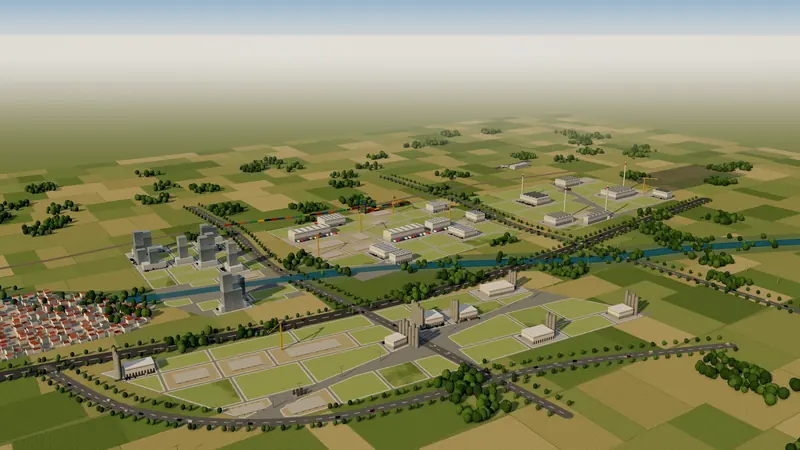
Where most opportunity lists stand today
A typical list names a project, a sector and a contact. It rarely says where the land is, how big it is, whether power reaches it or which incentives apply. The investor has to write and ask, and many never do.
The team then answers the same questions by email, one investor at a time, often from files that are already out of date. Good opportunities stay unseen because they look like every other line in the catalogue.
What an opportunity map shows
- Plots and sites on offer, each with its boundary, size, zoning, price and status.
- Projects that are not plots yet, such as PPP projects, tenders and land auctions, pinned to the place they concern.
- Roads, rail, ports, power lines, water and risk areas as layers, so distances and access are visible at once.
- The incentives and programmes that apply to each place, explained on the plot instead of in a separate brochure.
- Figures for each district or zone: land on offer, sectors already present and infrastructure being built.
What makes an investor act
A map that only shows dots is still a catalogue. Investors act when they can narrow the offer to their project and see a clear next step. That means filters for size, sector and distance, a card that answers the first questions on each opportunity, and a way to send an enquiry or reserve a plot from the same page.
Steps to publish one
- 1Collect what you already hold: plot boundaries or coordinates, project sheets, tender notices and incentive rules.
- 2Check that every opportunity has a location and a status, and drop the ones nobody can answer for.
- 3Agree what happens after an enquiry or a reservation request, and who receives it.
- 4Publish on your own domain, in the languages your investors read.
- 5Keep it current: when a plot is reserved or a tender closes, the map changes for every visitor at once.
How Business Builder Map does it
Business Builder Map is an investment attraction platform built on a map. Plots, opportunities such as tenders, PPP projects and land auctions, infrastructure layers and incentives sit on one Investment Map. Investors filter plots, run Site Selection for their project, check the numbers with the investor tools, ask questions in Ask BBM, and send an enquiry or book a plot online.
You can try it in the Demo Zone, a sample region with more than 100 plots.
Questions
What is the difference between an opportunity map and a project pipeline?
A pipeline is a list your team uses to follow projects. An opportunity map is what investors see: each opportunity on its land, with the facts they need to decide whether to get in touch.
Can we include projects that are not tied to a plot?
Yes. Tenders, PPP projects and land auctions can be pinned to the place they concern and linked to the plots around them.
Who keeps the map up to date?
Your team, from the data it already maintains. When a status changes, the map changes for every visitor.
Can it run in several languages?
Yes. It runs on your domain, with your brand, in the languages your investors read.
Read next
- What is an investment attraction platform?An investment attraction platform puts your land, infrastructure and incentives on one map. What it includes, how investors use it, and a free demo.Read
- For cities and regionsShow investors your city's land, infrastructure projects and incentives on one branded map, with plot search, site selection and requests. Free demo.Read
- Industrial land bank portalHow to put an industrial land bank online: every available plot and site on one map, with utilities, prices and incentives, and a path to allotment.Read
Demo Zone
See it working on a whole region
A sample region with 117 plots: the Investment Map, Site Selection, investor tools and online booking. No sign-up.
